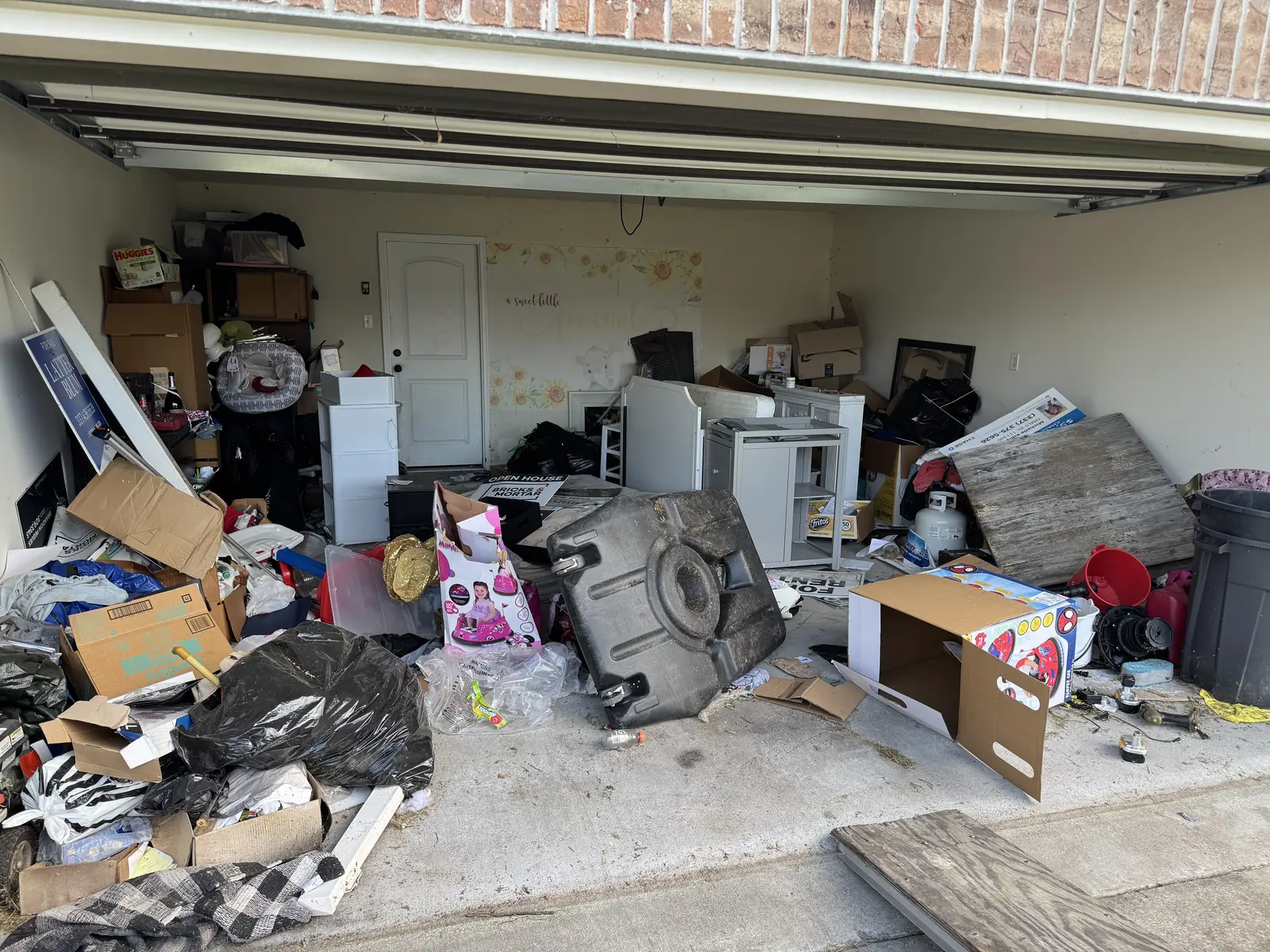
What a Garage Cleanout Actually Looks Like, Start to Finish
A garage cleanout is four steps: pull everything out, sort it into keep, donate, sell, and haul, decide fast on the gray-area items, then load the haul pile. Most single-bay garages take three to six hours. The sorting is the slow part, not the lifting.
- Empty the garage onto the driveway first. You cannot sort what you cannot see.
- Four piles: keep, donate, sell, haul. No fifth pile called “decide later.”
- Deciding takes longer than hauling. Budget your energy for that, not the muscle work.
- Ask what a hauler will take before the truck shows up. Klutter Krewe takes tires, batteries and paint (paint for an added charge). Ask first about fuel and propane.
- In 2018, the most recent year EPA has published, 80.1% of discarded furniture and furnishings went to a landfill. Donating the usable pieces is the easiest thing you can do differently.
Most people who call about a garage cleanout open with an apology. They do not need to. A garage fills up the same way everywhere: one box at a time, over years, while you are busy with something else. Nobody decided to do it.
Around here there is usually a second layer to it. After Laura and Delta, a lot of garages in Southwest Louisiana became temporary storage for whatever came out of the house during repairs. Then the repairs finished and the storage stayed. If that is your garage, you are in large company.
What are the four piles, and why do they work?
The four-pile sort is keep, donate, sell, and haul. It works because it forces a decision on every object instead of letting you shuffle things sideways. In 2018, the most recent year EPA has published, Americans generated 12.1 million tons of furniture and furnishings, up from 2.2 million tons in 1960, per EPA durable goods data. Most of that volume starts in rooms like yours.
Start by pulling everything onto the driveway. It feels backwards and it looks worse before it looks better, but an empty garage is the only way to see what you actually own. Half the stuff in a full garage is invisible because it is behind other stuff.
Keep
Things you have used in the last two years, or will use in a season you can name. “Camping gear for spring” counts. “In case I get back into woodworking” does not.
Donate
Furniture, tools, kids’ gear, and household goods that still work. If you would let a neighbor borrow it without a warning label, it is donatable.
Sell
Keep this pile small. Anything you are not willing to photograph and list this week belongs in donate or haul instead. A sell pile that never sells is just a slower haul pile.
Haul
Broken, soaked, moldy, missing parts, or obsolete. Storm-damaged particleboard furniture almost always lands here, and that is fine. See also: clearing a parent’s house.
Set a timer for thirty seconds per item. If you cannot decide in thirty seconds, the answer is almost always that you do not need it. Speed is not carelessness here. It is just removing the room where second-guessing lives.
Why does the deciding take longer than the hauling?
Because lifting is physical and deciding is not. A two-man crew can load a full truck in under an hour. That same truck can sit in the driveway for three hours while somebody stands over a box of extension cords. This is the single biggest surprise on almost every job.
The stall points are predictable. Photos and paperwork. Anything belonging to a kid who has moved out. Tools inherited from a parent. Half-finished projects. None of those are really about the object. That is fine, but it helps to know it is coming so you can set those items aside in one clearly marked box and keep moving.
Here is the practical version. Do the easy 80% first. Empty paint cans, warped plywood, dead lawn equipment, cardboard, the exercise bike. Clearing that volume early gives you room to work and momentum for the hard 20%.
What generally cannot go in a standard load?
Household hazardous waste is the usual exclusion, and rules vary by hauler and by parish. Ask before the truck arrives, not after it is loaded. This one question prevents most of the delays we see on cleanout days.
Plenty of haulers turn down paint, batteries, tires and fridges. Klutter Krewe takes all four, with an added charge for paint and for fridges full of spoiled food. Fuel, propane tanks, motor oil, pesticides and pool chemicals need a conversation first. Here is what Klutter Krewe will and won’t haul, and how the free Calcasieu Parish drop-off compares.
Do not stack a propane tank or a gas can in with general debris and hope it goes unnoticed. It creates a real hazard for the crew and at the landfill face, and a load can be refused at the gate. Pull those items out and set them aside before anyone starts loading.
The other question worth asking any hauler is what happens to the donatable pile. In 2018, per EPA’s product-specific data, 80.1% of discarded furniture and furnishings, about 9.68 million of 12.08 million tons, was landfilled. Sorting the still-usable pieces out yourself, before pickup, is the part you control.
Why do so many Southwest Louisiana garages look like this?
Because the storms left more debris here than the region was built to absorb. Southwest Louisiana’s construction and demolition debris reached 1,642,601 wet-tons in FY2021, roughly six times the normal 257,609 wet-tons per year, which the Louisiana DEQ 2023 Biennial Solid Waste Capacity Report attributes directly to Hurricanes Laura and Delta.
That number is about landfills, but it describes garages too. When a house is being repaired, the contents go somewhere. The garage is the somewhere. Then the roof gets finished, life restarts, and the boxes stay put for another few years.
The same LDEQ report notes that Southwest Louisiana has the shortest remaining landfill capacity in the state: 14 years for construction and demolition, 19 years for Type I and Type II. Statewide, in 2018, the EPA reported that 50% of US municipal solid waste was landfilled, at 4.9 pounds per person per day. None of that is a reason to feel guilty about clearing a garage. It is a reason to pull the donatable third out of the pile first.
How long does a garage cleanout actually take?
A single-bay garage with normal accumulation runs three to six hours. A two-car garage that has been filling since the storms is usually a full day, sometimes two. Those ranges assume you are sorting alongside the crew and making decisions in real time.
- First hour: Everything comes out onto the driveway. Fastest and loudest part of the day.
- Hours two through four: The four-pile sort. This is where the day is won or lost.
- Next hour or so: The haul pile gets loaded. Donations get boxed separately.
- Last thirty minutes: Sweep, and put the keep pile back deliberately instead of tossing it in.
That last thirty minutes matters more than it sounds. If the keep pile goes back the way it came out, you will be doing this again in eighteen months.
Common Questions About Garage Cleanouts in Lake Charles
These cover how involved you need to be, how much to sort ahead of time, and how to get a real number for your garage.
Do I need to be there the whole time?
For a garage, yes, at least for the sorting. Garages hold personal items mixed with obvious trash, and only you know which is which. Once the four piles exist and you have pointed at the haul pile, you can step away.
Should I sort before the crew arrives?
If you have the time and the energy, it helps a lot. Even separating the obvious donate items into one corner will shorten the day. If you do not have the time, that is normal too. Plenty of people sort as they go.
What about the boxes I still cannot decide on?
Put them in one place, label the outside with today’s date, and set a calendar reminder for six months out. If you have not opened the box by then, you have your answer. One box is a reasonable compromise. Twelve is just the garage again.
How do I get a real number for my garage?
Photos. Stand at the garage door and take three or four wide shots, plus close-ups of anything large or unusual like appliances, a piano, or storm-damaged furniture. Photos answer more questions in thirty seconds than a phone description does in ten minutes.
One more thing before you start
Pick a day when you are not also doing three other things. Cleanouts go sideways when they are squeezed between errands. Eat first, hydrate, and open the garage door early while it is still cool. In Southwest Louisiana that window closes fast.
Klutter Krewe is veteran-owned and serves Southwest Louisiana, handling anything from a single item to a full property cleanout. From Klutter to Clean.
Ready to get the garage back?
Send a few photos of what you are looking at and we will start the conversation from there. No pressure, no judgment about how it got this way.